In this guide
Can a Smart Lock Help You Manage a Rental Property Remotely?
Yes. A properly configured smart lock for rental property use can reduce physical key handovers by giving guests, cleaners and property staff their own digital credentials. Timed PINs, one-time passcodes, eKeys and access records can make check-in easier to manage without the owner standing at the door.
But the lock is only one layer. Reliable remote management also depends on the exact TTLock configuration, gateway requirements, internet connection, battery condition and physical compatibility with the entrance door.
The best setup should continue providing normal local access even when the property's Wi-Fi or mains electricity is temporarily unavailable.
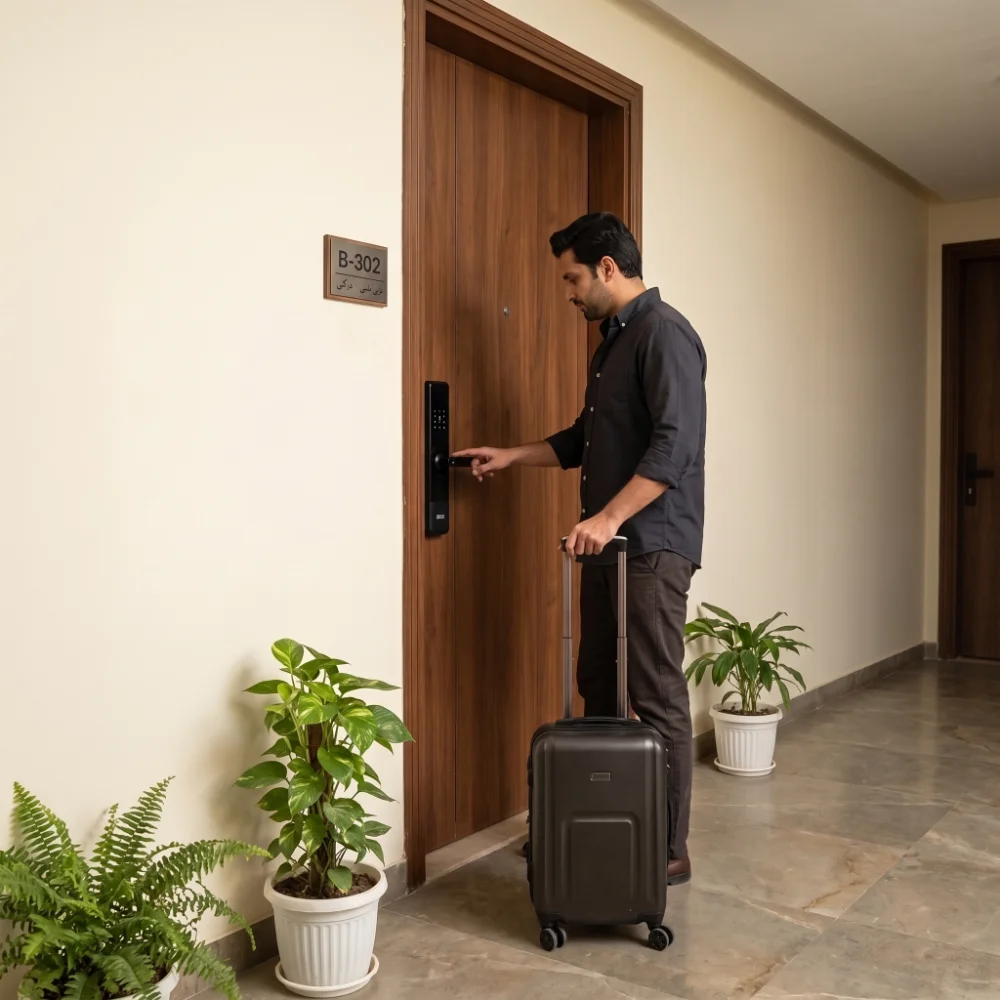
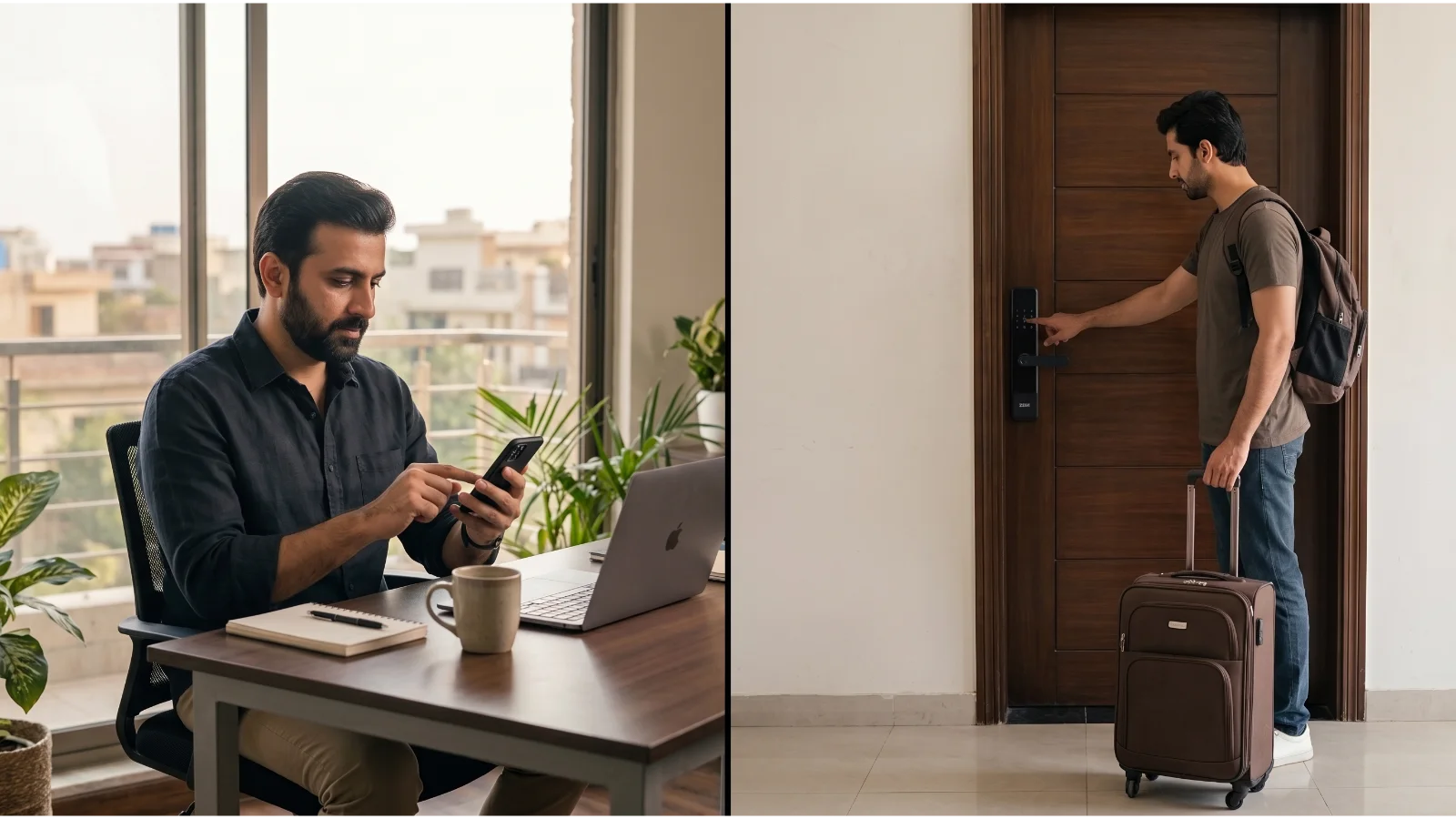
Consider a host living in Lahore while managing an apartment in Islamabad, or an owner in Karachi operating a holiday rental in Murree.
The booking itself can be managed online. Messages can be sent remotely. Payments can be tracked digitally.
Yet one physical problem remains: how does the guest actually get through the door?
If the answer is still “someone has to deliver the key,” the property is not truly operating remotely.
Why Physical Key Handover Becomes a Rental Bottleneck
Physical keys are simple until guest turnover increases.
A host may need to coordinate arrivals at midnight, arrange a key with a building guard, ask a cleaner to wait for a guest, replace a lost copy or change the lock when a former occupant still has access.
A smart lock changes the problem from key movement to credential management
Instead of asking “Who has the key?”, the owner can ask “Which credential should work, for whom, and for how long?” That is a much more scalable way to manage short-term access.
How a Remote Guest Check-In System Should Work
A smart lock is not the same thing as remote guest check in software. The lock is the physical access layer.
Booking platforms, messaging tools and property-management software handle other parts of the guest journey.
A strong workflow connects those operational steps without making the guest dependent on the host arriving in person.
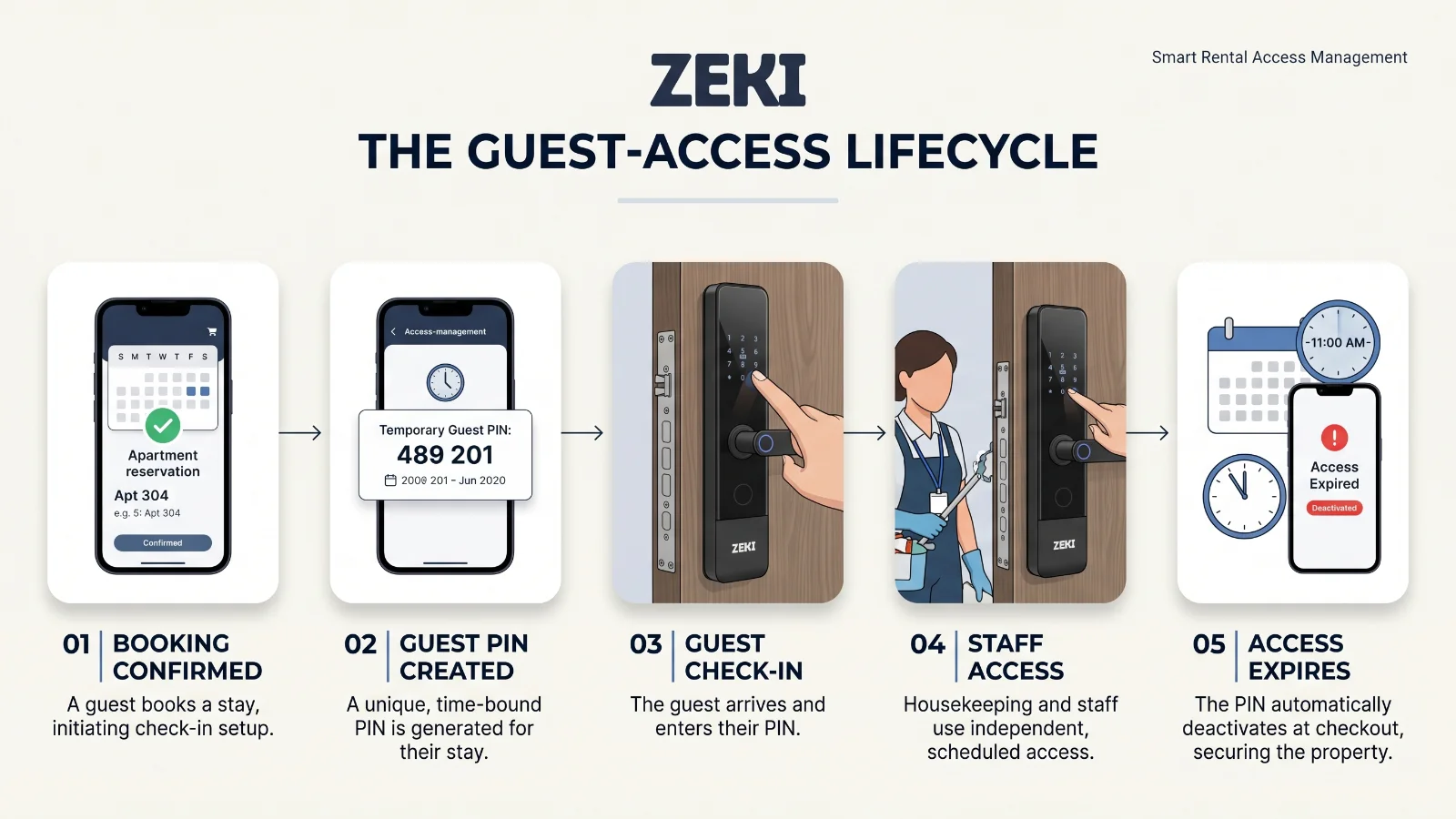
Confirm the Reservation
Verify the booking, guest identity requirements and intended check-in and checkout window before issuing access.
Create the Appropriate Credential
Use the access type suitable for that user, such as a timed PIN, supported one-time code or eKey.
Send Clear Entry Instructions
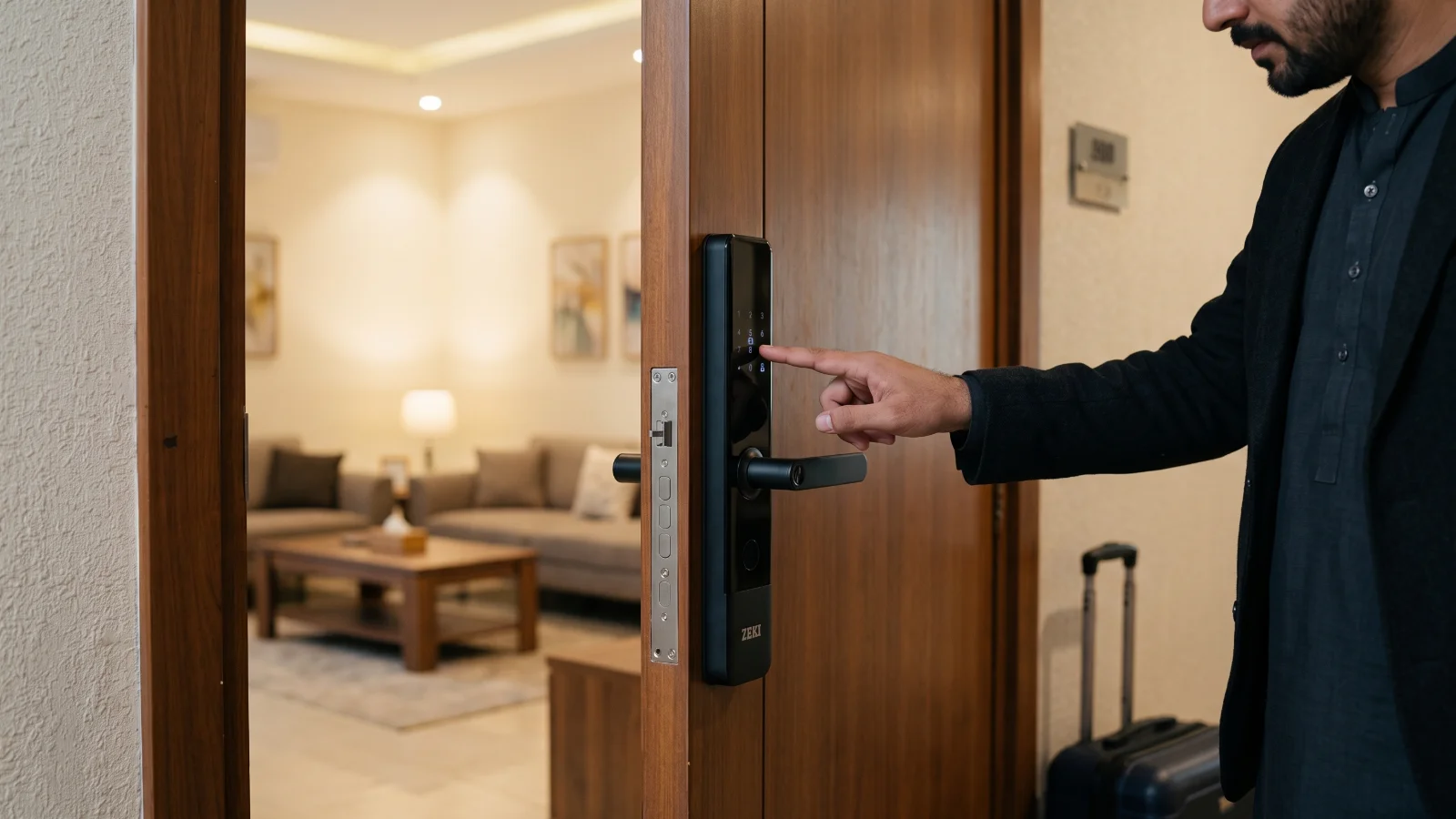
Explain where the entrance is, how to wake the keypad, how to enter the credential and what the guest should do if access does not work.
Keep Staff Access Separate
Cleaners, property managers, maintenance workers and guests should not all share one master password.
End Guest Access After the Stay
The guest credential should no longer provide unnecessary future access once the authorized stay has ended.
This is the foundation of an unattended check-in system: the property can receive an authorized guest without requiring the host to physically deliver a key.
Guest PINs, One-Time Codes, eKeys and Staff Access
Rental access works best when different people receive different credentials.
Giving every guest, cleaner and manager the same permanent PIN removes much of the operational benefit of moving away from physical keys.
| User | Useful Access Type | Why It Helps |
|---|---|---|
| Short-stay guest | Timed or temporary PIN | Access can be aligned with an authorized stay window. |
| One-off visitor | Supported one-time passcode | Useful when access should not remain reusable. |
| Property manager | Separate long-term credential | Keeps management access independent from guest codes. |
| Cleaner | Individual PIN, eKey or supported credential | Avoids sharing the owner's master access. |
| Owner | Fingerprint + admin access | Provides convenient regular access without depending on guest credentials. |
What Does a One-Time PIN Actually Do?
Buyers sometimes search for a one time pin generator expecting the lock to create an unlimited stream of completely custom codes from anywhere.
The real workflow depends on the platform and connection method. TTLock supports different passcode types on compatible hardware, including timed and one-time credentials. Some custom remote operations require the lock to be online through a compatible gateway or supported network connection.
That distinction is important for rental owners because creating a code and editing or deleting a particular code remotely are not always the same technical process.
eKeys Can Be Useful for Regular Managers
A supported TTLock eKey gives an authorized user mobile-based access rather than requiring the owner to share a permanent master PIN.
This can make more sense for a trusted co-host or property manager who accesses the property regularly.
Why the TTLock Gateway Matters for Remote Property Management
This is one of the most important details to understand before buying a TTLock-based lock for a rental property.
A Bluetooth smart lock can communicate directly with a nearby phone, but Bluetooth by itself does not put the lock onto the internet.
Where supported, a compatible TTLock gateway acts as the bridge between the nearby lock and the property's internet connection.
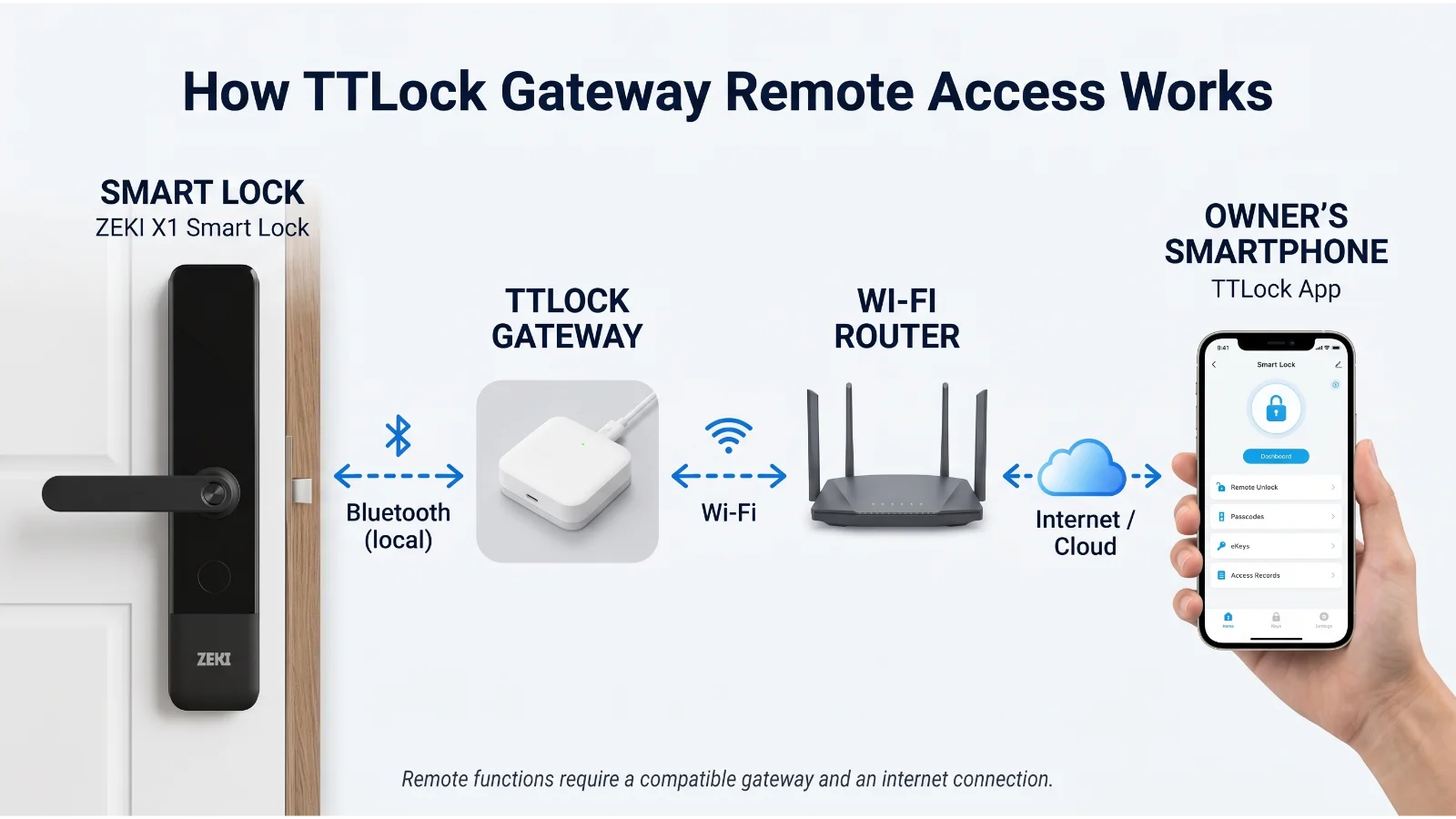
The guest uses a registered PIN, fingerprint, card or another supported local credential at the lock.
A compatible phone can communicate with a Bluetooth-based lock when it is within suitable range.
Supported live remote operations require an appropriate network path, such as a compatible TTLock gateway connected to the internet.
What a Gateway Can Add
On compatible TTLock setups, a gateway can support functions such as remote lock management, supported credential changes, automatic uploading of access records and network-based status functions.
Exact capabilities still depend on the lock and configured TTLock environment.
Remote management is a system, not a single lock feature
The lock, gateway, router, internet service and app account all form part of the remote workflow. If one network layer is offline, connected functions can pause even though registered local access at the door remains available.
Can You Connect a Smart Lock Directly to Airbnb in Pakistan?
Do not assume that buying any app-enabled lock automatically creates a direct Airbnb integration.
Airbnb recognizes smart locks and keypads as self-check-in methods, but its own direct connected-smart-lock feature is currently limited to eligible listings in the United States and Canada using specific supported lock brands.
That means a ZEKI X1 and TTLock setup in Pakistan should not be advertised as having native Airbnb smart-lock integration unless Airbnb or an explicitly compatible third-party system supports that exact workflow.
What About Property Management Integration?
Third-party property-management platforms can sometimes connect booking information with smart-lock systems and automate guest-code delivery.
However, property management integration must be checked between the exact PMS, lock platform and account configuration.
Do not assume that “TTLock compatible” automatically means your PMS can create, change and send codes without additional setup.
Software Cannot Replace a Backup Entry Plan
Even a well-designed remote system should have a recovery procedure.
Ask what happens if the guest's phone has no data, the router is offline, the lock batteries are exhausted, the gateway loses power or the guest mistypes the code.
A rental workflow is only strong when the failure path has also been planned.
Load Shedding, Fiber Dropouts and Remote Rentals
Pakistani rental properties need to be planned around the difference between local lock power and internet infrastructure power.
The ZEKI X1 operates on four AA batteries. Its normal local authentication therefore does not depend on continuous WAPDA or K-Electric mains electricity.
Your router, optical network terminal and TTLock gateway are different. Those devices normally require electrical power.
| Situation | Local Door Access | Remote Management |
|---|---|---|
| Normal mains + internet | Registered local credentials operate normally | Configured remote functions can operate |
| Load shedding, network equipment has backup power | Battery-powered lock remains independent of mains | May remain available if router, ONT and gateway stay online |
| Load shedding, router/gateway turns off | Registered local credentials can still be used | Internet-dependent functions may become temporarily unavailable |
| ISP or fiber dropout | Local authentication is separate from broadband | Connected functions may pause until connectivity returns |
| Lock batteries depleted | Normal electronic operation needs recovery power | Remote connectivity cannot substitute for a powerless lock |
PTCL and Fiber Connectivity Still Matter
A property can have electricity while the broadband link is temporarily unavailable.
PTCL routing delays, a local fiber internet breakdown, router restart or provider-side maintenance can interrupt cloud-connected functions without physically changing the guest's registered local PIN.
Put the Network Equipment on Backup Power if Remote Access Matters
If the property already uses a UPS, inverter or generator, consider whether the router, ONT and compatible gateway are actually connected to the backed-up circuit.
A building may advertise continuous backup power generation while the internet cabinet or individual apartment router still switches off during changeover.
Local voltage fluctuations are also more relevant to the powered networking equipment than to an AA-battery-powered lock itself.
How the Use Case Changes Across Pakistan
Furnished Apartment
A host may want flexible guest access while a cleaner and family member keep their own separate credentials.
Managed Rental Unit
Building entry and apartment entry may be separate systems. A smart lock on the unit does not automatically solve security-desk or building-access requirements.
Investor-Owned Apartment
For owners and real estate investors in Islamabad, remote credential management can reduce dependence on someone physically carrying keys between bookings.
Short-Stay Rental
Murree rental apartments can create a different challenge: the owner or manager may be hours away while guests arrive after a long road journey and expect immediate access.
Guesthouse or Multiple Units
When several rooms or properties are involved, credential naming, staff access and record management become as important as the unlocking method itself.
Scaling Beyond One Door
Once a business manages many doors, the requirement may start moving from a single residential smart lock toward structured commercial keyless access control.
What Is the Best Lock for Guesthouse Operations?
There is no universal best lock for guesthouse use.
A four-room property with one main entrance has different requirements from a hotel-style building with twenty independently managed doors.
Before choosing hardware, establish the number of doors, number of regular staff, guest turnover, required records, connectivity and whether each guest needs access to one door or several.
Treat Access as a Lifecycle, Not a Permanent Password
A rental lock is exposed to more user turnover than a typical family entrance.
That makes credential discipline particularly important.
What Does “Anti-Peep Decoy Keypad” Mean?
Marketplace listings sometimes use phrases such as anti-peep decoy keypad.
Do not rely on the label alone.
On the ZEKI X1, the verified feature is virtual-password protection. It allows unrelated digits to be entered before and after the actual registered password while the correct password remains within the full sequence.
This can make casual observation of a guest or staff PIN more difficult, but it does not replace sensible credential management.
Be Precise About Tamper Alerts
The ZEKI X1 includes anti-breaking and trial-and-error alarm functions.
However, buyers asking about tamper alert notifications should verify whether they mean a local lock alarm or a remote app notification.
Network-delivered notifications can depend on the installed gateway, account configuration and the event type supported by the lock.
The Rental Workflow Is Useless if the Lock Does Not Fit the Door
Software usually receives the attention.
The door still determines whether the installation can work properly.
Pakistani properties often use custom wooden entrance doors rather than one standardized door specification. Existing mortises, handle positions, decorative panels and frame clearances can all vary.
This becomes especially important for a premium wooden main door. Replacing an access code is easy. Repairing unnecessary door cutting is not.
Where the ZEKI X1 Fits a Rental Access Workflow
Once the rental-management requirements are clear, the ZEKI X1 becomes relevant for buyers who want TTLock-based credential management together with several local unlocking methods.
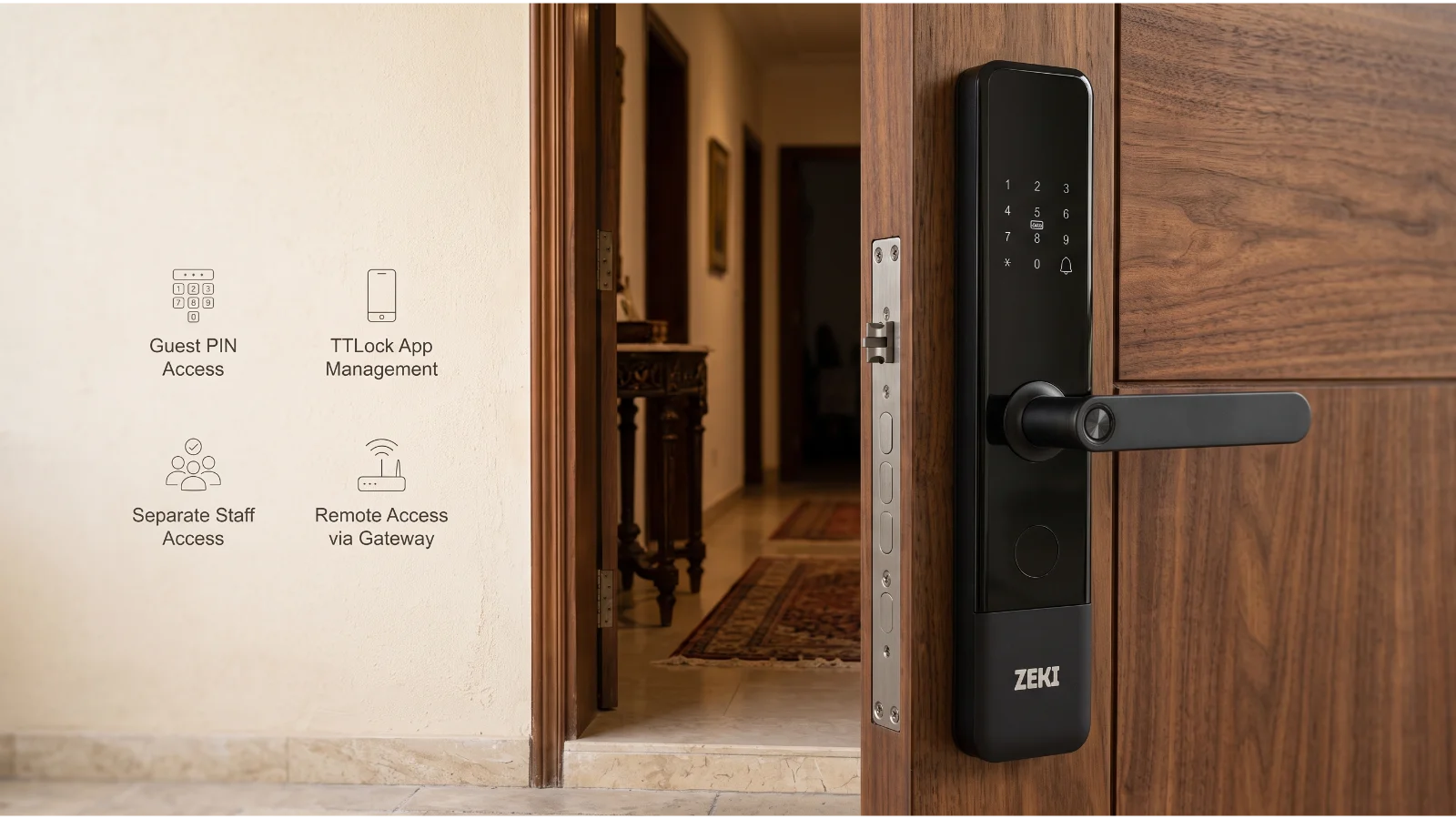
ZEKI X1 with TTLock
The current ZEKI X1 available from ZEKI Pakistan combines local biometric and keypad entry with TTLock-based management.
- Fingerprint access for enrolled regular users
- Password / PIN access
- IC-card access
- Mechanical-key backup
- TTLock app support
- Supported passcode and eKey management
- Virtual-password protection
- Anti-breaking alarm
- Trial-and-error alarm
- Low-battery warning
- Four AA battery operation
- Type-C emergency external power support
What the X1 Does Not Automatically Give You
Choosing the X1 does not automatically mean every TTLock cloud function is available from anywhere without additional hardware.
Supported remote operations can depend on a compatible gateway and the installed configuration.
It also does not create native Airbnb integration for a Pakistan listing simply because the lock uses an app.
This distinction is important because accurate expectations make the system more useful after installation.
Buyers comparing the safety of fingerprint-based access can also read our guide to fingerprint door-lock safety before choosing a biometric access method.
What to Check Before Buying a Rental Property Smart Lock
Do not start with the app name.
Start with the way the property will actually operate.
The Goal Is Controlled Self Check-In, Not Remote Unlocking for Every Guest
A well-planned rental system should let authorized guests enter with their own credential while the owner remains in control of who receives access and when. Remote unlocking can be useful in selected situations, but it should not become the normal solution for every arrival.
Planning a Smart Lock for Your Rental Property?
Not sure if your existing wooden door mortise, handle direction or frame clearance fits a digital lock?
Take a quick picture of your door, existing lock body and door edge and send it directly to the ZEKI Pakistan technical support team on WhatsApp at +92 304 7691488 for an initial compatibility assessment.
Also tell us whether the property is a family rental, Airbnb-style short stay, guesthouse or remotely managed apartment so the access requirement can be considered together with the door.
Smart Lock for Rental Property FAQs
Is a smart lock useful for a rental property in Pakistan?
Yes, particularly when the owner wants to reduce physical key handovers and give guests, cleaners or managers separate credentials. The exact benefit depends on the lock, connectivity setup and how frequently users change.
Can Airbnb guests check in without meeting the host?
A smart lock or keypad can support a self-check-in workflow in which an authorized guest enters using a provided credential instead of collecting a physical key from the host. The host should still provide clear instructions and a backup access procedure.
Does the ZEKI X1 connect directly to Airbnb in Pakistan?
Do not assume direct Airbnb integration. Airbnb's current direct connected-smart-lock feature is limited to eligible listings in the United States and Canada using supported lock brands. In Pakistan, the X1 and TTLock should be treated as a separate access-management system unless an explicitly compatible third-party platform provides the required integration.
Can TTLock create temporary or one-time guest codes?
TTLock supports several passcode types on compatible locks, including timed and one-time credentials. The exact method and whether particular remote management actions require a gateway depend on the lock and connectivity configuration.
Do I need a TTLock gateway for remote rental management?
A compatible gateway is required for supported live remote operations on Bluetooth-based TTLock locks because Bluetooth alone does not provide an internet connection. Some credential workflows can behave differently, so confirm the exact functions you need before purchasing.
Will the lock work during load shedding?
The ZEKI X1 uses four AA batteries for normal lock operation, so its local authentication does not depend on continuous WAPDA or K-Electric mains power. However, remote functions may become unavailable if the router, ONT or compatible gateway loses power.
What if the ZEKI X1 batteries become completely depleted?
The X1 provides Type-C emergency external power support and also has a mechanical-key backup. Rental operators should create a practical recovery plan before giving the property to unattended guests.
Can cleaners and guests have different access?
Yes, supported TTLock credential management allows different users to be assigned separate access methods rather than everyone sharing one permanent master PIN. The exact credential types available depend on the configured lock.
Can I see who opened the rental property?
TTLock supports access records on compatible configurations. How quickly records synchronize and whether notifications are available remotely can depend on the lock, gateway, internet connection and access method used.
Is a smart lock suitable for a guesthouse?
It can be, but the number of doors and users matters. A small guesthouse may be well served by individual smart locks, while a larger property may require more structured commercial access-control planning.
Can a smart lock integrate with property management software?
Some property-management systems support smart-lock integrations, but compatibility is not universal. Verify the exact PMS, smart-lock platform and required functions before building your check-in process around automation.
What should I check before ordering a rental property lock?
Confirm the required guest-access workflow, gateway and internet requirements, backup entry method, battery maintenance plan and physical door compatibility including thickness, mortise, backset, handle direction and frame clearance.